Releasing the Pressure
High-order surface flow discretizations via
discrete Helmholtz–Hodge decompositions
MotivationIncompressible flows on curved surfaces
- Arise in thin-film dynamics, biomembranes, and geophysical flows
- Two geometric constraints on the velocity $\uu$:
- tangential to the surface
- divergence-free
- $\Hdiv$-conforming BDM elements satisfy both exactly:
- pointwise divergence-free
- tangential
- pressure-robust
- need to solve velocity–pressure saddle-point system.
SettingThe surface (Navier–)Stokes equations
On a surface $M\subset\mathbb{R}^3$ find a tangential velocity $\uu$ and pressure $p$:
∇Operators on the surface
With $J$ the rotation by $90^\circ$:
Skip the saddle point —
work directly in the divergence-free subspace
Solve directly inside $\JL=\{\,\uu\in\mathbf{H}(\dive) : \dive\uu=0\,\}$, which splits as
ObservationTopology matters
Theory · smooth surfaceThe Helmholtz–Hodge decomposition
An $L^2$-orthogonal split into a gradient, a streamfunction rotation, and a harmonic field.
\(=\)
\(\oplus\)
\(\oplus\)
total field
gradient
streamfunction rotation
harmonic
Why it mattersTopology lives in the harmonic part
- For a divergence-free field the gradient term drops:
$$ \mathbf{H}^1\!\cap\JL = \rot(H^2\!\cap H^1_0)\ \oplus_{L^2}\ \mathbf{H}_N(M) $$
- The harmonic space $\mathbf{H}_N(M)$ is finite-dimensional:
$$ \dim \mathbf{H}_N(M) = b_1(M) \quad(\text{first Betti number}) $$
- It captures circulation around non-contractible loops, i.e., the net flow a streamfunction can never describe.
From smooth to discreteThe structure we want to keep
The smooth divergence-free space splits with the harmonic part capturing the topology:
Should be inherited by discrete velocity space:
!Not for free
Naive discretization gets the harmonic dimension wrong — spurious modes appear or genuine ones vanish, and the topology is broken.
?The question
What property of the discrete spaces guarantees the right split?
The answer · FEECDiscretize the complex, not the equation
The split comes from the de Rham chain complex, and the harmonic fields(...) are precisely its cohomology.
A finite-element sub-complex linked to the continuous one by commuting projections.
✓Cohomology is preserved
A compatible sub-complex reproduces the cohomology of the continuous complex — the central principle of FEEC.
#Topology is exact
The only non-trivial cohomology has dimension $b_1(M)$ — which forces the right harmonic count:
The discrete divergence-free space splits
Exactly the smooth decomposition — now realized in the BDM space:
↑ a direct dimension-counting argument — no FEEC machinery needed
Streamfunction
Continuous Lagrange $\Sbb_0^{k+1}$ — one scalar field $\psi_h$.
Harmonic
$\Hbb^k_\BDM$ — just $b_1(M)$ coefficients $\hh_h$.
Velocity
Recovered exactly: $\uu_h=\rot(\psi_h)+\hh_h$.
ConsequenceA pressure-robust, saddle-point-free problem
Find $\uu_h=\rot(\psi_h)+\hh_h\in\Jbb^k_\BDM=\rot(\Sbb_0^{k+1})\ \oplus_{L^2}\ \Hbb^k_\BDM$ such that
- Realization: exploit that $\Jbb^k_\BDM \subset \mathbf V_h=\mathbb{P}^k$ via embedding $T: \mathbb{R}^{N_J} \to \mathbb{R}^{N_{V}}$
- Compute $T$ via embedded Trefftz mechanism ($u_h \vert_{T} = \rot(\psi_h) \vert_{T}$ by Trefftz constraint $+$ conformity constraint)
- Solve the reduced system $$T^{\!\top} A_{\mathbf V}\, T\, \xx = T^{\!\top} \ff_{\mathbf V}$$
- How to deal with the harmonic component?
Algorithm 4.1Randomized harmonic basis
$\Hbb^k_\BDM$ has no local basis. We build an $L^2$-orthonormal basis in $b_1(M)$ steps — succeeding with probability one.
Random divergence-free sample. Draw a random $\rr_h$ and project it into the divergence-free subspace via the Helmholtz projection $\Pi_{\Jbb^k_\BDM}$.
Remove the streamfunction part. Solve a Laplace problem for $\psi_h$ and subtract $\rot(\psi_h)$ — what remains is a candidate harmonic field.
Orthogonalize & accept. Gram–Schmidt against the current basis; if non-zero, normalize and keep. Repeat until $b_1(M)$ vectors are found.
From geometry to meshPiercing the bunny
.stp geometryfrom netgen.occ import OCCGeometry, Cylinder, Pnt, Y
import netgen.meshing as meshing
# load the CAD geometry of the bunny
occgeoshape = OCCGeometry("bunny.stp").shape
# pierce a cylindrical hole through the body
cyl = Cylinder(Pnt(5, -300, 32), Y, r=10, h=500)
shape = occgeoshape - cyl
if smooth_hole: # round off the rim
shape = shape.MakeFillet(shape.edges, 2)
shape = shape.Scale(Pnt(0, 0, 0), 0.01)
occgeo = OCCGeometry(shape)
# mesh the surface only — a closed 2-manifold
ngmesh = occgeo.GenerateMesh(
perfstepsend=meshing.MeshingStep.MESHSURFACE,
maxh=maxh, minh=0.5*maxh, grading=0.7)
from ngsolve import Mesh
mesh = Mesh(ngmesh)


In code · comparisonSaddle-point HDG vs. the streamfunction solver
a = BilinearForm(𝔹𝔻𝕄)
a += (gradu | gradv) * ds(...)
a += (gradu*n | tang(vhat-v.Trace())) \
* ds(..., element_boundary=True)
a += (gradv*n | tang(uhat-u.Trace())) \
* ds(..., element_boundary=True)
a += alpha*order**2/h \
* (tang(vhat-v.Trace())
| tang(uhat-u.Trace())) \
* ds(..., element_boundary=True)
a += -div(u.Trace()) * q.Trace() * ds(...)
a += -div(v.Trace()) * p.Trace() * ds(...)
a = BilinearForm(ℙᵏ)
a += (gradu | gradv) * ds(...)
a += (gradu*n | tang(vhat-v.Trace())) \
* ds(..., element_boundary=True)
a += (gradv*n | tang(uhat-u.Trace())) \
* ds(..., element_boundary=True)
a += alpha*order**2/h \
* (tang(vhat-v.Trace())
| tang(uhat-u.Trace())) \
* ds(..., element_boundary=True)
aemb = emb.T @ a.mat @ emb
Numerical experiments · validationEquivalent to velocity–pressure — at lower cost
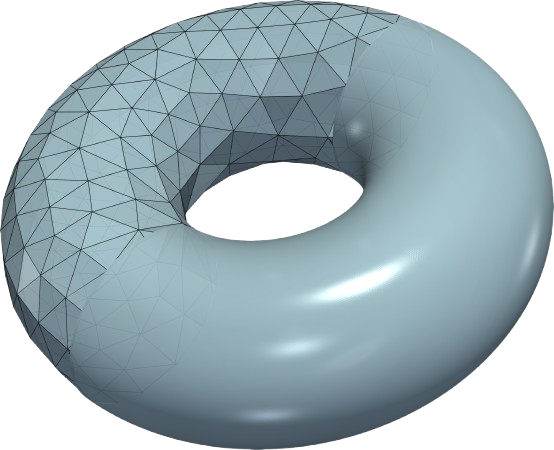
Steady surface Brinkman problem on the torus, $k=2$. Relative $L^2$ discrepancy to the velocity–pressure HDG of [Lederer et al.]:
| $N_{\mathcal T}$ | $\|\uu^{\mathrm{vp}}-\uu^{\mathrm{sf}}\|/\|\uu^{\mathrm{vp}}\|$ | $\|\dive\uu^{\mathrm{sf}}\|$ |
|---|---|---|
| 782 | 3.6 × 10⁻⁸ | 3.9 × 10⁻¹¹ |
| 1214 | 3.4 × 10⁻⁹ | 8.8 × 10⁻¹¹ |
| 4740 | 2.8 × 10⁻⁸ | 1.9 × 10⁻⁹ |
Discrete velocities agree up to solver / quadrature tolerances and stay divergence-free.
▼Fewer degrees of freedom
Trefoil knot, $k=2$, genus 1:
$27\,920 + 2$ total dofs
$48\,860 + 20\,940 = 69\,800$ total dofs
Experiment · genus 1Trefoil knot
- A closed, orientable tube embedded as a knot: topologically a torus of genus $g=1$.
- Number of harmonic fields is the first Betti number $b_1(M)=2g$.
- Computable from the mesh via the Euler characteristic:
$$ \chi(M)=V-E+F=2-2g \;\;\Longrightarrow\;\; b_1(M)=2-\chi(M) $$
Experiment · genus 1The trefoil flow in motion
Experiment · genus 0, with boundaryPierced sculpture surface
- Sphere with three large holes and one small hole (genus 0), four boundary rims, $\dim\Hbb^k_\BDM=3$.
- Rigid-body-rotation forcing, no-slip rims, $k=4$; the small hole triggers a Kármán vortex street.
- Again the harmonic part dominates the initial transient and the final quasi-periodic regime, concentrated on the smallest hole.
Experiment · genus 0, with boundaryThe sculpture flow in motion
In summaryReleasing the pressure
Discrete HH decomposition
The BDM divergence-free space splits exactly into a streamfunction rotation and a harmonic field.
Topology is captured
$\dim\Hbb^k_\BDM=b_1(M)$: the discrete complex preserves cohomology on surfaces of any topology
No saddle point
Solve with a scalar streamfunction + finitely many harmonic coefficients. Exact tangentiality, pointwise div-free, pressure-robust, high order.
Questions welcome
Brüers · Lehrenfeld · van Beeck · Wardetzky — University of Göttingen
Implemented in Netgen/NGSolve with the NGSTrefftz add-on.